
If you live in Ahmedabad or frequently travel between the city and Gandhinagar, you are likely familiar with the Sarkhej-Gandhinagar Highway. Locals simply call it SG Highway. Over the last decade, this stretch of road has evolved from a dusty bypass into the beating heart of new Ahmedabad. Among the many infrastructure upgrades that have reshaped this corridor, the Gota Chokdi Flyover stands out as a vital piece of the puzzle.
It was not too long ago that reaching the Gota intersection meant bracing yourself for a long wait. The traffic snarls were legendary. Vehicles would pile up, engines idling, as commuters watched the signal turn from red to green and back to red again without moving an inch. Today, that experience is vastly different. The construction of this flyover has not only changed the area’s skyline but also fundamentally altered the daily lives of thousands of commuters.
Why This Flyover Was Necessary
To understand the significance of the Gota Chokdi Flyover, we need to look at the area’s geography. Gota serves as a gateway. It sits at a strategic point where traffic from the main city meets the flow heading toward the state capital, Gandhinagar. It also intercepts heavy vehicle movement heading toward North Gujarat.
Before the flyover was constructed, the junction at Gota was a major bottleneck. The volume of traffic simply outgrew the capacity of the surface-level road. The government and urban planners recognised that a simple road widening would not suffice. They needed a solution that separated local traffic from the through traffic.
The primary goal was ambitious yet simple. The authorities wanted to convert SG Highway into a signal-free corridor. This meant eliminating the need for vehicles travelling long distances to stop at every crossroad. The Gota flyover was a critical step in achieving this signal-free vision.
Engineering and Design Features
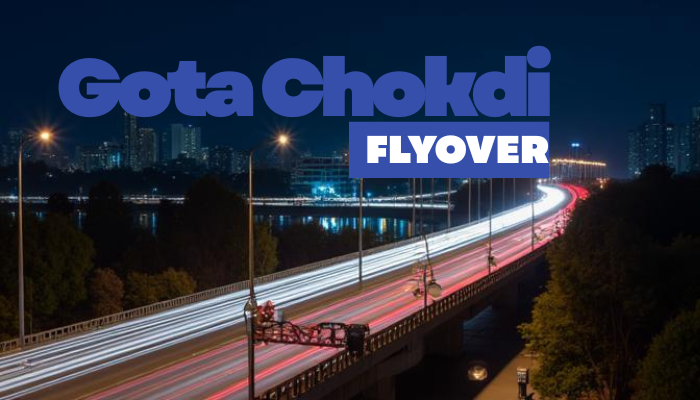
When you drive over the flyover today, you notice the smoothness of the ride. The structure is built to handle high-density traffic with six lanes. This width ensures that fast-moving cars can overtake slower vehicles without creating dangerous situations.
The engineering focus was on durability and flow. The approach roads leading up to the flyover have a gentle gradient. This design choice is important because it prevents heavy vehicles from slowing too much as they climb, keeping traffic moving at a steady pace.
Lighting is another key feature. Installing high-quality LED streetlights ensures excellent visibility at night. This is crucial for safety, especially during the monsoon season when heavy rains can obscure vision. The drainage systems integrated into the flyover design also help prevent waterlogging, a common issue that often plagues infrastructure projects during the Gujarat monsoon.
Impact on the Daily Commute
The most immediate benefit of the Gota Chokdi Flyover is the time saved. For a daily commuter travelling from Sarkhej to Gandhinagar, skipping the Gota signal can save anywhere from five to ten minutes during peak hours. When you add that up over a week or a month, the time saved is significant.
There is also the factor of fuel efficiency. Constant braking and accelerating at traffic signals consumes a lot of fuel. By allowing vehicles to maintain a constant speed, the flyover helps drivers achieve better fuel efficiency. This has a positive ripple effect on the environment, as it slightly reduces the carbon emissions concentrated at that specific junction.
Stress reduction is an often-overlooked benefit. Driving through heavy traffic is exhausting. The mental fatigue of navigating a chaotic junction is removed when you can simply glide over it. You arrive at your destination feeling a little fresher and less frustrated.
Boosting the Gota Real Estate Market
Infrastructure development almost always leads to economic growth, and Gota is a prime example of this rule. The completion of the flyover has acted as a catalyst for the local real estate market.
A decade ago, Gota was considered a distant suburb. Today, it is a prime residential hub. The improved connectivity means that living in Gota is no longer a compromise. You can live in a spacious apartment in Gota and still reach your workplace in Sola, Thaltej, or even Prahlad Nagar in a reasonable amount of time.
Real estate developers have capitalised on this. The skyline around the flyover is dotted with high-rise residential schemes and commercial complexes. Property prices in the vicinity have appreciated steadily. Families prefer the area because of the easy access to schools, hospitals, and the highway. The flyover essentially shrunk the distance between Gota and the rest of Ahmedabad.
Connectivity Beyond the Highway
While the flyover primarily serves the SG Highway, it also facilitates better lateral movement. The service roads beneath the flyover have been reorganised to manage local traffic better. This allows people heading into the internal sectors of Gota or crossing over to the Science City side to do so with less hassle.
This junction is also significant because of its proximity to the railway line. The connectivity aids those heading to the railway station or moving goods from nearby transport hubs. It acts as a pivot point that balances the heavy industrial traffic with private commuter vehicles.
The Bigger Picture: A Signal-Free Future
The Gota Chokdi Flyover is not an isolated project. It is part of a grander narrative of Gujarat’s infrastructure growth. It works in tandem with other flyovers at Sola, Thaltej, and Vaishnodevi Circle. Together, these structures form a chain that allows for seamless travel.
For a first-time visitor driving into Ahmedabad, this infrastructure leaves a lasting impression. It signals that the city is modern, efficient, and ready for business. For the locals, it is a sign of progress. It shows that tax rupees are being utilised to create tangible assets that improve the quality of life.
Conclusion
The Gota Chokdi Flyover is more than just concrete and steel. It is a symbol of how thoughtful urban planning can solve complex problems. It has turned a chaotic chokepoint into a smooth thoroughfare.
Whether you are a daily commuter enjoying a faster drive to work, a real estate investor watching your property value rise, or just a resident enjoying the modern feel of the neighbourhood, the impact of this flyover is undeniable. It has successfully bridged the gap between the old traffic struggles and a faster, more connected future for Ahmedabad. As the city continues to expand, infrastructure like this ensures that growth does not come at the cost of mobility.
If you want to read more information, visit