

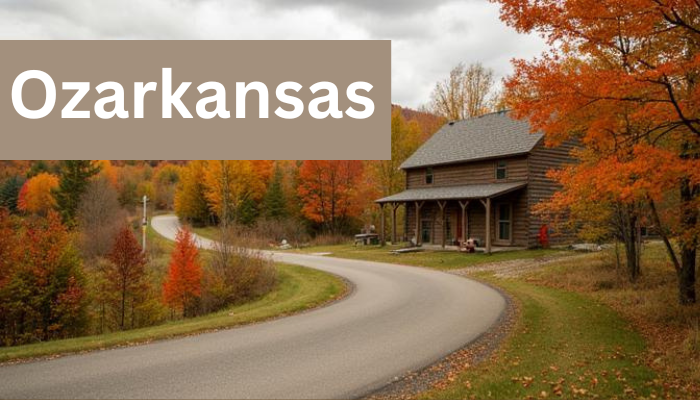
There is a distinct shift in the atmosphere when you cross into the northern tier of Arkansas. The horizon stops being a straight line and begins to ripple, rising and falling in deep, green waves. This is the realm of “Ozarkansas.” It is a portmanteau that does more than just blend a state and a mountain range; it captures a specific cultural and geographical identity. It represents the section of the Ozark Plateau that claims the Natural State as its home, a place where the geology is as rugged as the history is rich.
To understand this region, you must first understand the stone. The foundation of Ozarkansas is limestone and dolomite, carved over aeons by water. This karst topography has created a landscape that feels secretive and alive. It is a world of hollows, which locals pronounce as “hollers,” and steep ridges that seem to hold onto the mist long after the sun has risen. This geological personality sets the stage for everything else, from the winding architecture of the roads to the clear, cold water of the springs.
The Crown Jewel: The Buffalo National River
If this region has a heartbeat, it pulses through the Buffalo National River. As the first designated national river in the United States, the Buffalo remains undammed and wild. It flows freely for 135 miles, cutting through massive limestone bluffs that tower hundreds of feet above the water. These bluffs, painted in streaks of grey, orange, and white mineral deposits, serve as a cathedral for outdoor enthusiasts.
Floating the Buffalo is a rite of passage here. In a canoe or kayak, drifting over water so clear you can count the pebbles on the riverbed, the modern world feels incredibly distant. You might spot an elk wading near the banks in the Boxley Valley or hear the splash of a smallmouth bass breaking the surface. It is an experience of profound quiet, interrupted only by the sound of rushing shoals and the wind moving through the oak and hickory canopy.
A Tale of Two Cities: Eureka Springs and Bentonville
The human footprint in Ozark, Arkansas, is just as fascinating as the natural one. The region is anchored by towns that could not be more different, yet are separated by less than an hour’s drive.
First, there is Eureka Springs. To walk its streets is to step into a Victorian fantasy. Built into steep hillsides, the streets wind and loop in such a confusing manner that none of them crosses at right angles. The town was founded on the belief in healing waters, and that history of sanctuary remains. It is an enclave for artists, free spirits, and preservationists. The architecture is elegant and eccentric, featuring gingerbread trim and limestone walls that seem to grow directly out of the mountain.
Travel west, and you encounter the modern face of the region in Bentonville. Once a sleepy town, it has transformed into a global hub of culture and commerce. This is the home of the Crystal Bridges Museum of American Art, a world-class institution nestled in a ravine. The museum architecture bridges the water, harmonising with the forest rather than dominating it. Here, high culture meets the high trails, as Bentonville has also crowned itself the mountain biking capital of the world. It is a place where you can view a Norman Rockwell painting in the morning and shred miles of single-track trail in the afternoon.
The Sound of the Hills
You cannot talk about this area without mentioning the sound. The folk roots run deep here, preserved in the mountains’ isolation for generations. Mountain View, a small town to the east, keeps this heritage alive. It is known as the Folk Music Capital of the World, and for good reason. On any given warm evening, the impulsive energy of music takes over the town square.
Musicians gather on front porches and park benches to play. There are no amplifiers and no tickets sold. It is simply the organic joy of fiddles, banjos, and guitars weaving together ancient melodies. This is the music of the Scots-Irish settlers who found a landscape that reminded them of home. They planted their culture in the rocky soil, and it bloomed into a tradition of storytelling and song that defines the region’s emotional landscape.
The Scenic Route
In Ozark, Arkansas, the destination is rarely as important as the drive itself. The roads here were dictated by the terrain, meaning there are very few straight lines. The Pig Trail Scenic Byway is perhaps the most famous stretch of pavement in the state. It twists through the Boston Mountains, offering tunnel-like passages of foliage that explode into fiery reds and golds during the autumn months.
Motorcyclists and sports car enthusiasts flock to these roads, not just for the technical challenge of the switchbacks, but for the views. There are moments when the trees break, revealing vistas of rolling blue hills that extend as far as the eye can see. It is in these moments, standing at an overlook with the cool mountain breeze on your face, that the term “Ozarkansas” makes perfect sense.
A Culinary Renaissance
The region has also moved far beyond simple country cooking, though you can certainly still find excellent biscuits and gravy. The culinary scene has evolved to reflect the area’s biodiversity. Chefs in towns like Fayetteville and Rogers are embracing “High South” cuisine. This movement focuses on local ingredients, utilising the region’s abundance.
You will find menus featuring trout fresh from the White River, mushrooms foraged from the hardwood forests, and produce grown in the fertile river valleys. It is sophisticated dining that retains a sense of place. It feels unpretentious yet elevated, much like the region itself.
The Enduring Spirit
What truly defines Ozarkansas, however, is the hospitality. The pace of life here invites conversation. People wave from their trucks as they pass. Strangers chat in line at the general store. It is a culture that values connection.
Whether you are exploring the subterranean wonders of Blanchard Springs Caverns, standing in awe of the glass chapel in the woods at Thorncrown, or simply sitting on a porch watching the fireflies rise from the grass, the region wraps around you. It creates a sense of belonging.
Ozarkansas is not merely a spot on a map. It is a convergence of art, nature, and history. It is the rugged elegance of the Ozark Mountains filtered through the warm, welcoming soul of Arkansas. For those willing to take the winding road less travelled, it offers a sanctuary that is as restorative as the healing springs that first put it on the map.
If you want to read more information, visit