
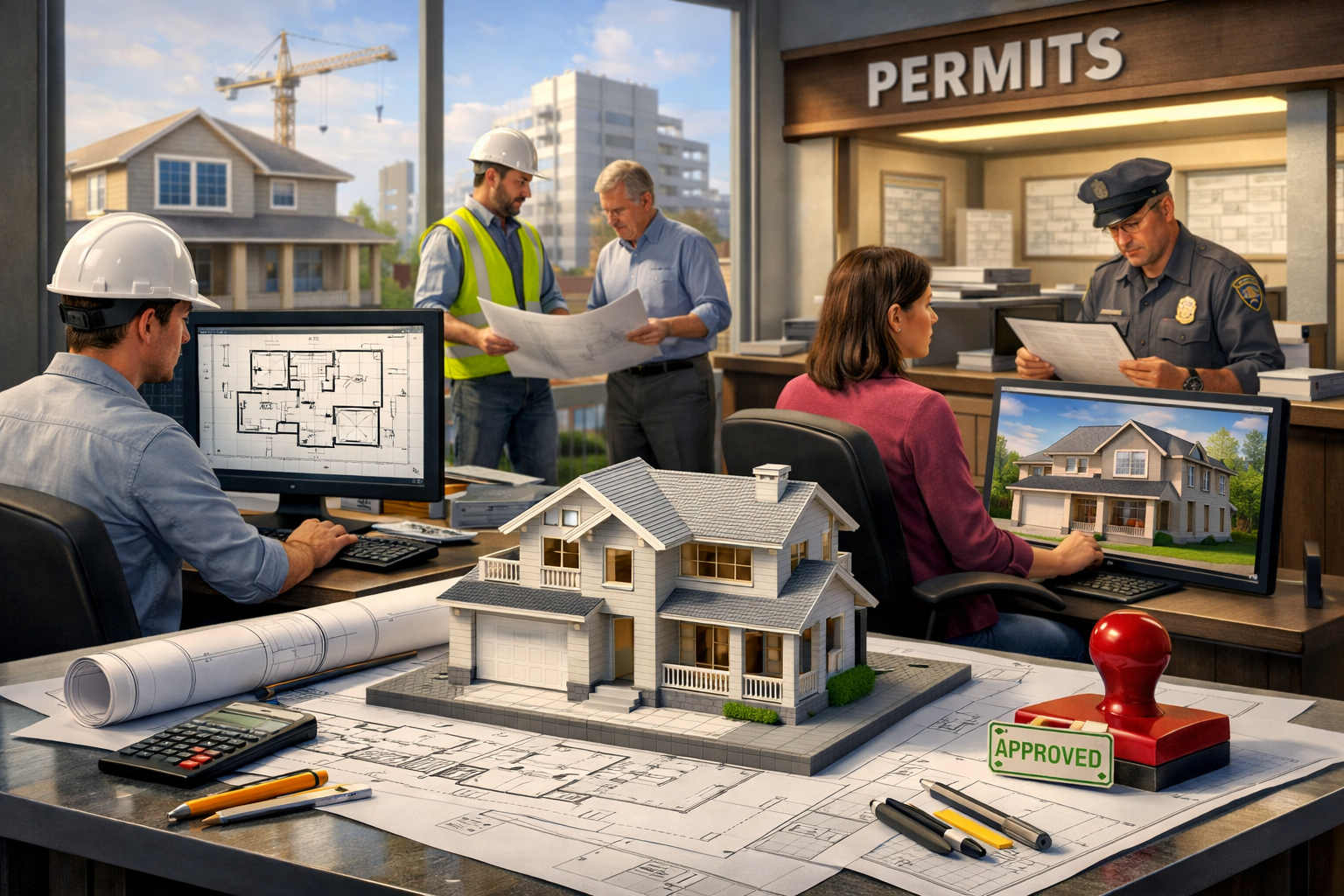
Walk into any planning office in London, Manchester, New York, or Chicago, and you’ll see the same thing: stacks of drawings under review. Some are digital. Some are scanned copies of decades-old blueprints. All of them are being evaluated against strict regulatory standards.
In 2026, one small drafting error can delay a permit by weeks. A misaligned dimension, an inconsistent scale, or a missing annotation can trigger a revision request and every revision costs time and money.
That’s why accurate CAD conversion service providers are no longer viewed as back-office support. They are now part of a company’s compliance strategy.
For architects, engineers, developers, and construction firms operating in the UK and globally particularly those using cad conversion services in USA for large-scale or multi-state projects precision in digital drawings is directly linked to faster permit approvals.
Let’s explore why.
Why Do Permit Approvals Depend So Heavily on Drawing Accuracy?
Permit approvals are not subjective. They are technical.
Local planning authorities, building control officers, and municipal reviewers evaluate submissions based on:
- Scale accuracy
- Structural clarity
- Code compliance annotations
- Layer organization
- Dimension consistency
- Fire safety, accessibility, and zoning alignment
If your drawings were converted from paper plans, PDFs, or raster files into CAD format, any inaccuracy during that process becomes a compliance risk.
According to a report by McKinsey & Company, construction productivity has historically lagged other industries, with rework and coordination inefficiencies contributing significantly to delays.
Permit revisions are one of the most overlooked contributors to that inefficiency.
What Is CAD Conversion And Why Does It Affect Compliance?
CAD conversion involves transforming:
- Paper drawings
- Scanned blueprints
- Raster images (TIFF, JPG)
- Legacy PDFs
- Outdated CAD formats
into fully editable, scalable CAD files such as DWG or DXF.
2d cad conversion services specifically focus on floor plans, elevations, sections, and technical schematics that are often required in permit submissions.
The problem? Conversion is not just tracing lines.
It requires:
- Scale calibration
- Layer restructuring
- Annotation verification
- Dimension cross-checking
- Code compliance alignment
If these steps are rushed or automated without proper validation, the result is technically incorrect drawings even if they look visually accurate.
How Do Inaccurate Drawings Delay Permit Approvals?
Let’s break this down.
1. Dimension Inconsistencies
Even a 5mm difference between structural drawings and floor plans can raise red flags during review.
Permit officers often verify:
- Wall thickness
- Stair widths
- Door clearances
- Ceiling heights
If converted drawings distort original scale, approval gets paused.
2. Missing Regulatory Annotations
Many legacy paper drawings lack modern compliance notes. During conversion, these must be updated to reflect:
- Accessibility standards
- Fire safety regulations
- Energy efficiency requirements
In the UK, guidelines often reference frameworks aligned with the National Building Specification (NBS). In the US, compliance varies by state and municipality.
Failure to integrate updated annotations during conversion creates unnecessary back-and-forth with planning departments.
3. Poor Layer Management
Modern CAD submissions require structured layer naming conventions.
Permit reviewers expect organized files, not flattened or merged layers.
An experienced best cad conversion service provider ensures drawings meet current CAD standards rather than simply replicating legacy formatting.
Are Permit Authorities Becoming Stricter in 2026?
Yes and more digital.
Across the UK and USA, planning authorities are moving toward digital-first submission systems.
According to research from Autodesk, firms using digital drafting and BIM-integrated systems report improved coordination accuracy and reduced rework.
This shift means:
- Files must integrate seamlessly with digital review tools
- BIM compatibility is increasingly expected
- Drawing clarity is scrutinized more closely
Authorities are not just checking compliance they are checking file integrity.
Why Are U.S. Firms Investing More in CAD Conversion Services?
The construction market in the United States is under pressure from:
- Skilled labour shortages
- Accelerated infrastructure projects
- Stricter state-level compliance
- High cost of project delays
When developers use cad conversion services in USA, they are often managing:
- Multi-state projects
- Renovation of legacy commercial buildings
- Infrastructure modernization
- Smart factory upgrades
In these scenarios, outdated drawings must be digitized before submission.
A poorly converted file can delay an entire approval cycle.
In high-value projects, that delay can mean tens of thousands of dollars in holding costs.
How Do 2D CAD Conversion Services Support Permit Success?
Many firms assume 3D cad modeling or BIM is the main focus.
But in reality, most permit submissions still rely heavily on 2D drawings.
2d cad conversion services ensure:
- Clean, scalable floor plans
- Accurate sections and elevations
- Clear dimensioning
- Structured annotation layers
These files form the foundation of regulatory review.
If the 2D files are flawed, even advanced BIM workflows cannot compensate.
What Trends Are Shaping CAD Conversion in the UK and USA?
1. AI-Assisted Conversion
AI tools now assist with:
- Raster-to-vector recognition
- Pattern detection
- Symbol identification
- Batch processing
However, AI still requires human validation. Regulatory drawings cannot tolerate interpretation errors.
2. BIM-Ready Outputs
Planning departments increasingly prefer drawings that can integrate into BIM environments.
Conversion providers must structure files for interoperability with tools like AutoCAD and Revit.
This requires deeper technical knowledge than basic redrafting.
3. Sustainability & Documentation
In the UK especially, sustainability reporting and carbon documentation are influencing building submissions.
Digitized drawings make energy modeling and compliance reporting easier but only if the source files are accurate.
What Happens When You Choose the Wrong CAD Conversion Partner?
The risks are not minor.
- Rejected permit submissions
- Multiple revision cycles
- Contractor disputes
- Fabrication errors
- Loss of client trust
The cheapest provider is rarely the safest choice.
An accurate cad conversion service combines:
- Automation efficiency
- Multi-stage QA review
- Dimension verification
- Industry-specific drafting expertise
How Can Businesses Reduce Permit Risk Through Better Conversion?
Here are practical steps:
1. Request a Pilot Project
Test the provider with a small drawing set.
Evaluate:
- Layer structuring
- Annotation clarity
- Dimension precision
2. Confirm QA Process
Ask:
- How is scale verified?
- Is manual review included?
- Are compliance notes updated?
3. Ensure Software Compatibility
Files should integrate smoothly with:
- AutoCAD
- Revit
- BIM coordination platforms
4. Prioritize Industry Experience
Architectural, mechanical, and structural drawings require different knowledge bases.
Choose the best cad conversion service provider with relevant sector expertise.
Is Automation Replacing Drafting Professionals?
No.
It is redefining their role.
Instead of repetitive tracing, professionals now focus on:
- QA oversight
- Compliance alignment
- BIM integration
- Cross-disciplinary coordination
Automation speeds up production. Human expertise ensures regulatory reliability.
What Is the Future of Permit-Ready CAD Documentation?
Looking ahead, expect:
- Fully digital planning portals
- Automated compliance checks
- BIM-integrated submission workflows
- AI-assisted drawing validation
- Standardized cross-border drafting formats
As infrastructure modernization accelerates across the UK and USA, accurate digital documentation will become foundational not optional.
Final Thoughts:
Permit approvals are one of the most critical checkpoints in any construction or renovation project.
And increasingly, the success of that checkpoint depends on the quality of your digital drawings.
Accurate conversion is not just about clean lines. It’s about:
- Regulatory alignment
- Risk reduction
- Faster approvals
- Reduced rework
- Stronger project margins
For firms navigating complex approval processes in the UK and globally, partnering with a technically experienced CAD conversion specialist can significantly reduce compliance friction.
Leading UK-based CAD design firms like Shalin Designs are supporting architects, engineers, and construction companies with precision-driven conversion workflows that prioritize dimensional accuracy, structured layering, and BIM compatibility helping businesses move from archive to approval with confidence.
In 2026 and beyond, the firms that treat drawing accuracy as a compliance strategy not just a drafting task will gain a measurable competitive advantage.
FAQs
Why are CAD conversion services important for permit approvals?
Accurate CAD conversion services ensure drawings meet regulatory standards, maintain scale precision, and include proper annotations. In the USA and UK, planning authorities require structured, compliant digital files to approve permits without delays.
How do CAD conversion services reduce permit rejection rates?
An accurate CAD conversion service minimizes dimension errors, incorrect layering, and missing compliance notes. This reduces revision cycles and prevents submission rejections during municipal or planning reviews.
What is the role of 2D CAD conversion services in construction permits?
2D CAD conversion services convert paper drawings, scanned plans, and PDFs into editable CAD files. These 2D plans are essential for building permits, zoning approvals, and structural compliance checks.
How much do CAD conversion services cost in the USA in 2026?
In 2026, CAD conversion services in USA typically range from $5 to $50 per drawing, depending on complexity, source quality, and volume. Bulk projects often offer lower per-drawing costs.
Can CAD conversion services help with BIM compliance in the UK?
Yes. Professional CAD conversion providers structure files for BIM compatibility, helping UK firms meet Level 2 and Level 3 BIM standards required for many public and infrastructure projects.
What should I look for in the best CAD conversion service provider?
Look for:
- Multi-stage QA process
- Industry-specific experience
- BIM compatibility
- Secure data handling
- Clear accuracy guarantees
Choosing the best CAD conversion service provider reduces compliance and rework risks.
Are CAD conversion services necessary for legacy building renovations?
Yes. Legacy buildings often rely on outdated paper or PDF drawings. CAD conversion digitizes these files into accurate, scalable formats required for modern permit approvals and renovation projects.